
SHRM data shows team-building jumped from zero to a named L&D focus in one year. Here is why managers, not courses, decide whether learning sticks, and how Predictive Index turns team-building into a science.

For years, I have watched L&D departments pour money into learning management systems, course libraries, and beautifully designed certification tracks.
Then wonder why engagement never moves.
SHRM just published the data that explains why.
In SHRM's 2026 L&D Priorities and Perspectives report, 40% of L&D leaders said fostering a culture of learning is one of their biggest challenges.
Seventeen percent called it their single greatest organizational challenge. Full stop.
Read that again. Not budget. Not buy-in from the C-suite.
Culture.
Here is the direct answer for any HR leader reading this: access to training was never the real problem.
The team around your people is.
You can hand your people every course, every certification path, every gorgeous learning journey, and it still will not move the needle.
Because a course by itself is just an empty water bottle. It looks like hydration. It is not anything until something fills it.
SHRM's own findings say the same thing in plainer language.
Even with training resources in place, employees can struggle to find the time, motivation, or team support to actually apply what they learn.
That is cultural dehydration in action. Not because the bottle is missing, but because there is no dispenser.
No manager creating the time to use what was learned. No team reinforcing it.
You can hand someone an empty bottle as many times as you want. It still will not quench anything.
You have to build the water source, the culture, that actually fills it.
Here is the number buried in SHRM's report that stopped me cold.
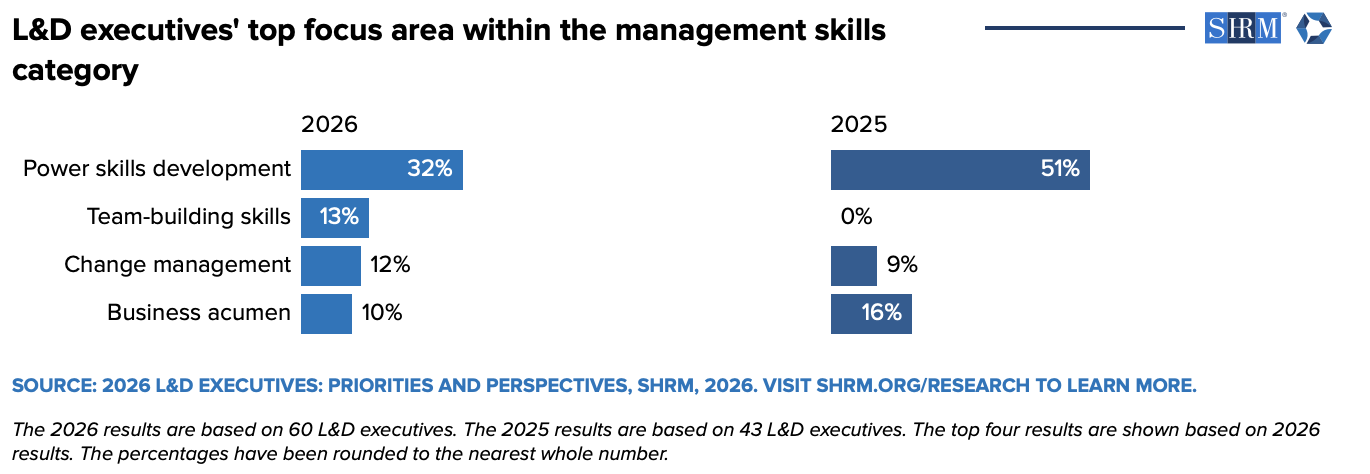
Among L&D executives who ranked management skills as a top priority, 13% now name team-building as their focus area. Up from zero the year before.
Zero to thirteen. In one year.
This is not a trend. It is a correction.
L&D leaders are finally naming what culture work has said for years. Managers make or break whether learning sticks.
Strong teams create the trust, accountability, and reinforcement that turn a completed course into an actual change in behavior.
As Aaron Hollinger, senior researcher at SHRM, put it, the jump from zero shows more leaders now think about performance as a collective outcome, not just an individual one.
Look closer at the report and the story gets more interesting.
Power skills development, the L&D world's long-standing top priority, dropped year over year. Meanwhile team-building climbed from nothing.
Leaders are not just adding team-building to the list.
They are pulling focus and budget away from generic skill-building to put it toward something more specific: the manager's ability to actually build a team.
That is not addition. That is reallocation.
When a category that dominated the prior year loses share to make room for a brand-new focus area, it means leaders are convinced the old approach was not delivering.
And they are willing to bet budget on something that has not been tested at scale yet.
The organizations that get ahead of that bet, instead of catching up to it in 2027, are the ones that will own this conversation.
So if 2026 is the year team-building becomes a management priority, the next question is obvious.
How are you actually going to build stronger teams?
Trust falls and offsite scavenger hunts did not get you here. They will not get you there either.
This is exactly where the Predictive Index earns its place in your 2026 strategy.
Not as another HR tool collecting dust, but as the diagnostic instrument that turns team-building from a guessing game into a science.
Most of the HR leaders reading this have already run PI somewhere in their organization. It is not new, and this is not a re-pitch of what it is.
What is worth talking about is why it actually changes how teams get built, and why so many organizations still do not see the difference.
PI's behavioral and cognitive data replaces assumption with evidence.
Instead of guessing why two strong performers keep clashing, or why a promising hire stalls under one manager and thrives under another, you can see the behavioral drives creating the friction.
Or the fit.
That is the difference between building a team on purpose and building one by accident.
Here is the part most organizations miss. The assessment is not what builds the team.
What a manager does with it is.
That is true of PI. It is true of every HR platform your organization has ever purchased.
The data can sit in a dashboard indefinitely if nobody is accountable for pulling it into a 1:1, a hiring decision, or a conflict conversation.
That is the exact gap SHRM's report is describing. The reason 40% of L&D leaders point to culture, not access, as their biggest challenge.
The tool was never the missing piece. The habit of using it was.
So the real question for 2026 is not whether your organization has PI, or a learning platform, or a performance system.
It is whether your managers are held accountable for actually using what those tools tell them.
Adoption is not a training rollout you check off once. It is an ongoing leadership expectation.
Without that accountability, even the best behavioral science in the world becomes another dashboard nobody opens.
What separates PI from the team-building fads that cycle through every few years is that it is not a trend.
It is built on decades of validated behavioral and cognitive research, not a framework someone invented last quarter.
That matters. The organizations winning in 2026 will not be the ones chasing the newest team-building buzzword.
They will be the ones whose managers understand the humans they are leading, backed by data that does not expire the moment the next trend shows up.
Before you invest in another course, ask yourself three questions.
Do your managers actually understand how each person on their team is wired to work? Or are they guessing?
When you build a new team, is the composition intentional? Or just convenient?
Can your managers tell you, specifically, what motivates each direct report? Or just what motivated them?
If you answered guessing, convenient, and not really, you do not have a learning problem.
You have a diagnosis problem.
SHRM just handed HR leaders a mandate. Team-building is no longer optional, and managers are the mechanism.
Predictive Index gives you the science to make that mandate specific instead of vague. But the data only becomes a repeatable, measurable process when managers are actually held accountable for using it.
The science was never the hard part. The discipline to act on it, week after week, is.
This is the same pattern I write about in Thirsty. The tools that promise hydration only work when someone builds the water source around them.
If you are already using PI, the real question is not whether you have it. It is whether your managers are actually using it the way it was built to be used.
If that accountability piece is not there yet, that is exactly the gap I help close.
Let's talk about how PI is being used inside your organization right now, and whether a hands-on workshop for your managers would help turn that data into a habit instead of a dashboard nobody opens.
Where does the cycle actually break down for your team? Is it the data nobody is using, or the manager nobody is holding accountable for using it?
Start a conversation at premierrapport.com/contact.
Shelley D. Smith, the culture curator behind Premier Rapport, is its CEO and the author of Thirsty. A Certified Predictive Index Partner, executive coach, and speaker, she has spent 35+ years across hospitality, franchise operations, and organizational leadership helping companies detect and repair culture before it shows up in the numbers.
Learn more at premierrapport.com/about or start a conversation at premierrapport.com/contact.
Team Building Rises as an L&D Priority for 2026, SHRM (reporting on the 2026 L&D Priorities and Perspectives report), August 5, 2026. Source for the 40% and 17% culture-of-learning figures, the 13%-up-from-zero team-building figure, and the Aaron Hollinger quote.
2026 L&D Executives: Priorities and Perspectives, SHRM, 2026. The underlying research report.
How does the Predictive Index improve workplace culture?
The Predictive Index replaces assumption with behavioral and cognitive evidence. Instead of guessing why two strong performers clash or why a hire stalls under one manager and thrives under another, leaders can see the behavioral drives creating friction or fit. That turns team-building from a guessing game into a deliberate design decision. But the data only improves culture when managers are held accountable for using it in 1:1s, hiring, and conflict conversations.
Can behavioral assessments predict culture fit?
Behavioral assessments like the Predictive Index reveal how a person is wired to work: their drives, their pace, their communication style. That data can predict where someone will fit and where friction is likely. It cannot decide the outcome on its own. A manager still has to act on what the assessment shows, which is why accountability for using the data matters more than the score itself.
How do you use PI for team building?
Use PI to build teams on purpose rather than by accident. Map each person's behavioral drives, compose new teams intentionally instead of conveniently, and give managers the language to understand what motivates each direct report. Then make using that data an ongoing leadership expectation, woven into 1:1s and hiring decisions, not a one-time rollout you check off.
Why did team-building become an L&D priority in 2026?
SHRM's 2026 L&D Priorities and Perspectives report found that 13% of L&D executives who named management skills a top priority identified team-building as their focus area, up from zero the year before. Leaders are recognizing that managers, not courses, determine whether learning sticks. Access to training was never the real problem; the team and manager around your people is.
Why is access to training not enough to build a culture of learning?
In SHRM's 2026 report, 40% of L&D leaders cited fostering a culture of learning as a challenge and 17% called it their greatest organizational challenge. Even with training resources in place, employees struggle to find the time, motivation, or team support to apply what they learn. A course by itself is an empty bottle. The culture and the manager are the water source that fills it.
Explore articles, case studies, and resources - crafted to keep you ahead.