
You were handed a change to make and no one who reports to you. Here is why authority cannot produce behavior, and what to measure instead.

For most of my career I would have called it resistance.
Somebody announces a change. The months go by, nothing moves, and you start quietly wondering who is blocking it.
I was wrong about that for a long time.
Here is the claim I will spend the rest of this piece defending: an announced change that never takes hold is almost never a resistance problem. It is an instruction that arrived without a method attached.
I found the evidence for it while I was looking for something else.
We have been building a record of who is buying companies in Hampton Roads. How many transactions, who is behind them, what happens to the people inside afterward.
Somewhere in the middle of that, I came across a study that had nothing to do with Hampton Roads and everything to do with the problem I have spent 35 years on.
A consulting firm called Accordion, which sells finance transformation to companies owned by private equity, ran two surveys last year.
First they asked two hundred private equity sponsors, the investors who own these companies outright, whether they had told their finance chiefs to make artificial intelligence a priority.
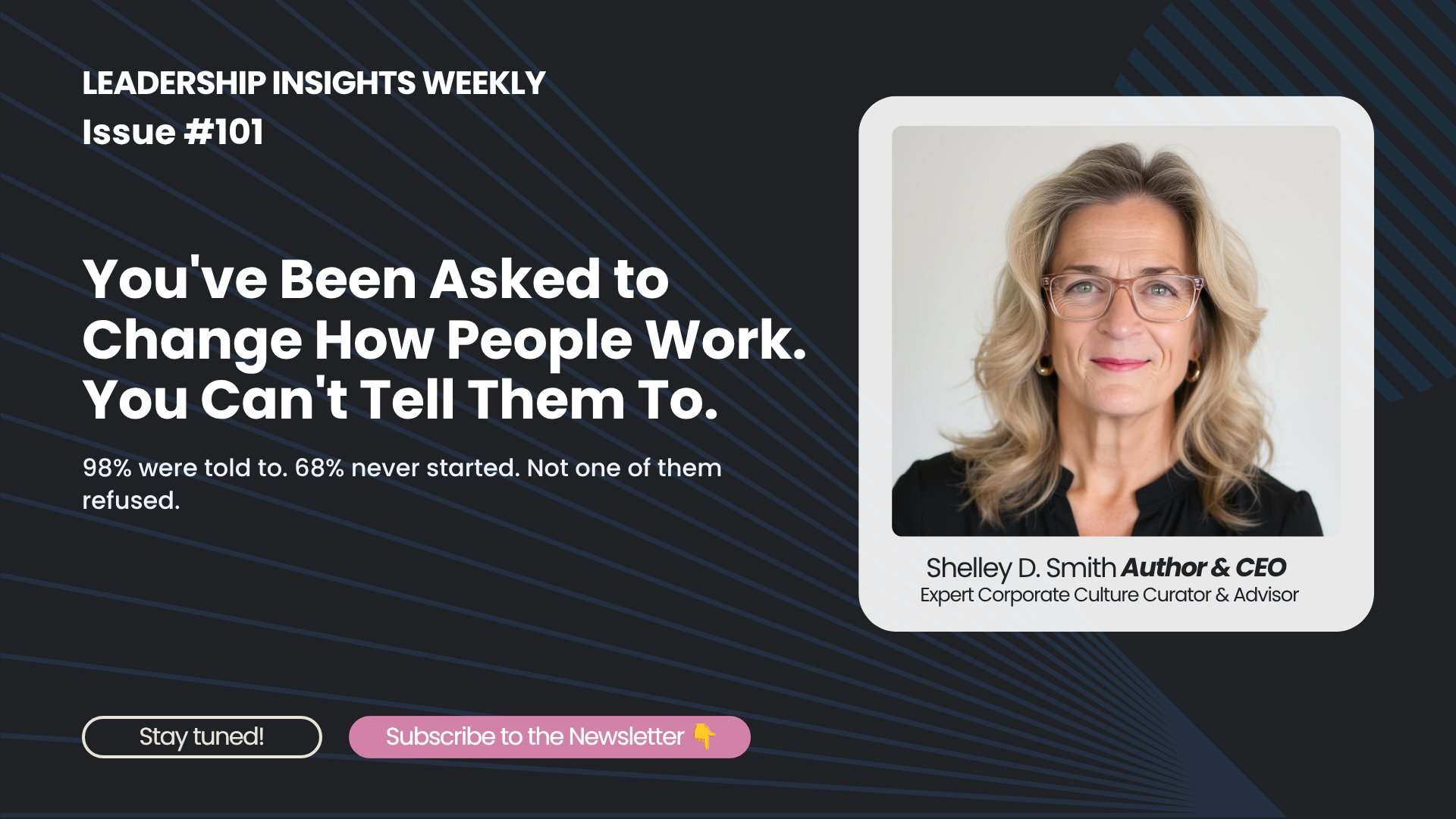
Ninety-eight percent had.
Hold that for a second, because these are not ordinary bosses. A sponsor does not manage a portfolio CFO.
A sponsor owns the company that CFO works for, and can replace them with a phone call.
If an instruction survives anywhere, it survives there.
Then they asked two hundred finance chiefs at private-equity-backed companies what had actually happened.
They had hung back. Sixty-eight percent said it was because they did not know where to begin, or who to turn to for help.
Disagreement was not among the reasons they gave.
That is not resistance. That is an instruction with no method attached.
If you have ever announced something clearly, watched every head in the room nod, and then watched four months go by with nothing moving, I think that is where your four months went.
Somebody handed you a change to make. They gave you a deadline, a deck, and a number.
What they did not give you is one single person who reports to you.
You have responsibility for how a few hundred people behave and authority over none of them.
There is a specific kind of tired that comes with that. Nobody warns you about it, and most people do not feel like they can mention it.
I have watched this setup play out for a long time now.
It always gets described as a rollout. Communicate it, train on it, track it, report the numbers up.
That all sounds reasonable. Right up until you notice what nobody put on the list.
Nobody ever says: and here is how you will know whether a single person actually changed.
The plan assumes telling people is the hard part.
Telling people is the easy part. Telling people takes forty minutes and a decent slide deck.
The hard part starts when the meeting ends.
Before I go further I should be straight with you about who ran that study.
Accordion sells the kind of help these companies are not buying.
A finding that finance chiefs are stalled and do not know who to ask is close to the most useful thing they could possibly publish, and I hold that part loosely.
This next part is different, because I cannot think of a single reason a vendor would go hunting for it.
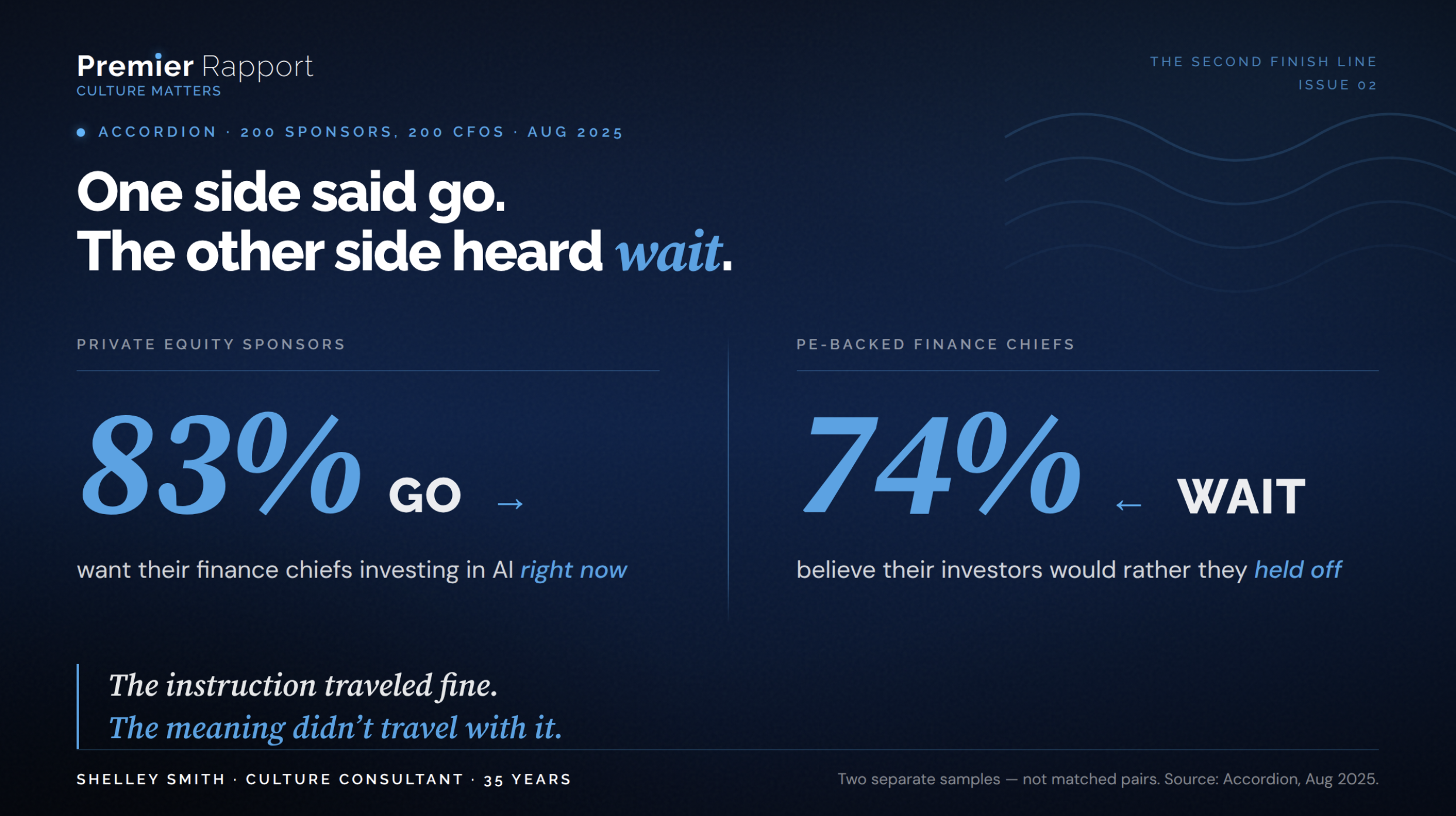
Eighty-three percent of the sponsors said they wanted their finance chiefs investing right now.
Seventy-four percent of the finance chiefs said they believed their investors would rather they held off and waited.
Those are two separate groups of people, so nobody here is calling anybody a liar.
But it is the same two roles, in the same industry, in the same season, describing the same relationship in opposite directions.
One side is saying go. The other side is hearing wait.
Notice what is sitting underneath that. Nobody in either group was guessing on purpose.
They were guessing because guessing is what people do when they have been given a direction and no method.
A method would have told them how fast, and how much.
The instruction traveled fine. The meaning did not travel with it.
An organization handles an instruction it cannot execute about the way a body handles a foreign object.
Not with hostility. With containment.
It gets absorbed somewhere in the middle of the org chart and quietly buffered so the actual work can keep moving.
Your supervisors and your team leads are the immune system, and I mean that with real affection.
The job they are measured on is keeping the thing running today.
So when something lands that they cannot translate into Tuesday morning, they do not refuse it. They hold it.
It goes in the standing meeting, takes four minutes, and rolls to next week.
And the honest status update, the one there is no box for, is this: I do not know how to do this and I am not saying so in front of nine people.
For a long time I went looking for the person who was blocking it. I want to save you that search, because there usually is not one.
None of that is sabotage. Every one of those small acts of buffering is completely defensible on its own.
It is only when you add them up across forty supervisors and nine months that you get a change which technically launched and never happened.
Which is why the postmortem never finds anything. There is no moment where it failed. There is no meeting where somebody killed it.
It just got absorbed.
If you are inside a merger right now, or you can see one coming, this is the version of it that costs the most.
When two companies combine, the working assumption is that the new one does not need two of everything. So the roles that look duplicated get examined first.
And the person carrying culture is very often sitting in one of them.
Here is why that is costlier than it looks, and this part is not my opinion.
Bermiss and Murmann published work in the Strategic Management Journal on which executive departures actually threaten a firm's survival.
Not acquisitions specifically. Seventy years of advertising firms, which is a cleaner test, because nobody was reorganizing around a deal.
The most costly departures are the internally focused roles.
Not because those people are more talented than anybody else. Because what they know is specific to your company, and it does not exist anywhere outside your building.
They also found that losing people from several functions at once does more harm than losing several from the same one.
An earlier study in that same journal, by Cannella and Hambrick, looked at ninety-six acquisitions and found something I would put on a wall.
Give even one or two of the acquired company's leaders a real seat on the combined leadership team, and performance afterward improves.
Not a transition title. Not a ninety-day advisory role. A seat.
So the person being asked to hold an organization together while quietly wondering whether there is a chair for them on the other side is, on the evidence, one of the more valuable people in the building.
I have stopped being surprised by that assignment. I have never stopped thinking it is a mistake.
If that is you right now, reading this between two meetings, I want you to know the research is on your side even when the org chart is not.
So the obvious conclusion is that you needed more authority. A mandate. The CEO on the video. Something with teeth.
I understand the instinct, and I think it is wrong.
Authority is very good at producing compliance. It is almost useless at producing behavior.
Compliance is what people do while somebody is watching, and it evaporates the moment the watching stops.
Behavior is what people do on a Thursday in month nine, when nobody is checking and the old way is faster.
No amount of authority reaches Thursday in month nine.
That gap between compliance and behavior has a name, and it is the one word nobody wants to use in a room full of executives.
Culture is just what people do when nobody is checking.
Not the values on the wall. Not the survey score. What actually happens on Thursday in month nine.
You cannot order a person to want it.
Everybody senior already knows this. It is just uncomfortable enough that we keep reaching for the mandate anyway.
It is not a bigger announcement.
It is not a better deck, a longer training, or a sponsor with a sharper title.
It is much smaller than any of those, which is exactly why people do not believe it works.
There is support for this from a direction you might not expect, though by now you may have already guessed it.
Economists at the National Bureau of Economic Research spent this year studying why artificial intelligence takes hold inside one company and stalls inside another.
What predicted it was not budget size, and it was not the strength of the mandate.
It was the company's personnel practices, and whether anybody had actively made it safe for people to try.
Now read that next to the finance chiefs I opened with.
They did not stall because they disagreed. They stalled because they did not know where to begin or who to ask.
Which is another way of saying that nowhere in that building was it safe to say so out loud.
Two studies, opposite ends, same finding.
I do not think it is really about technology, and I do not think it stays inside technology either.
A good part of those 35 years has been spent in hotel lobbies and conference rooms, watching a change quietly not happen.
That is an economics paper arriving exactly where I have been standing, and I will take it.
You were handed a change and no authority to enforce it.
So how would you know, today, whether it is actually taking hold?
I am not talking about whether the training got completed. Not whether the survey came back green.
Whether people work differently when nobody is watching.
Most people I ask cannot answer that.
I want to be careful here, because this is usually the moment people start apologizing to me.
It is not a failure of attention. It is not you being disorganized, and it is not you being bad at your job.
It is that nobody ever wrote down what normal looked like before any of this started.
Without that, you have nothing to compare Thursday in month nine against.
You are being asked to prove that something moved, and nobody recorded where it was standing.
If you want something to do this week, it is three things, and none of them require permission.
Name the behavior, not the announcement. What should somebody be doing differently on a Tuesday morning?
If you cannot answer that in a sentence, neither can they.
Ask three supervisors how they would actually do it. If they cannot say, the instruction arrived and the method never did. That is your gap, and it is fixable.
Record where it stands today, before anything moves. Who speaks in meetings. How decisions travel. What language people use about each other. That is your baseline, and it is the least exciting sentence in this entire piece.
There is a version of this job that works. It starts before the announcement instead of after it.
And it begins with knowing what you had.
Then somebody has to own whether it actually changed. Not own the announcement. Not own the plan. Own the answer to the question I just asked you.
Most companies find that out at the exact moment they need the comparison and do not have one.
I do not want that to be you.
That work is what the Flow-State Culture Framework is built for, and it is the seat I sit in when an organization does not need a permanent executive whose entire job is culture, but does need somebody in that chair for the stretch where it decides things.
If any of this sounds like your building, start a conversation. Thirty minutes, no pitch. I will ask what is actually happening and tell you honestly whether I can help.
Shelley D. Smith, the culture curator behind Premier Rapport, is its CEO and the author of Thirsty. A Certified Predictive Index Partner, executive coach, and speaker, she has spent 35+ years across hospitality, franchise operations, and organizational leadership helping companies detect and repair culture before it shows up in the numbers.
Learn more at premierrapport.com/about or start a conversation at premierrapport.com/contact.
Accordion, AI in the PE-Backed Finance Function. Two samples: 200 private equity sponsors and 200 PE-backed CFOs, released 11 August 2025. Reported by CFO Dive, 21 August 2025. Carries the 98 percent, 68 percent, 83 percent, and 74 percent figures. The two samples are independent, not matched pairs.
Bermiss, Y. S., and Murmann, J. P. Who matters more? The impact of functional background and top executive mobility on firm survival. Strategic Management Journal 36(11), 1697 to 1716, 2015. Studies New York City advertising firms, 1924 to 1996, with firm survival as the outcome.
Cannella, A. A., and Hambrick, D. C. Effects of executive departures on the performance of acquired firms. Strategic Management Journal 14, 137 to 152, 1993. Ninety-six acquisitions.
National Bureau of Economic Research, Working Paper 34995: Mind the Gap, AI Adoption in Europe and the U.S., March 2026. The paper does not claim causality and neither does this piece.
Why do change initiatives fail even when nobody objects?
Because an instruction is not a method. People who do not know how to execute a change rarely refuse it. They absorb it, holding the work in standing meetings and rolling it forward until the initiative technically launched and never happened. In Accordion's survey of 200 private-equity-backed finance chiefs, 68 percent said they had not acted because they did not know where to begin or who to turn to for help. Disagreement was not among the reasons they gave.
How do you drive change when you have no authority over the people who must change?
You stop trying to produce compliance and start building the conditions for behavior. Authority reliably produces compliance, which lasts only as long as somebody is watching. Behavior is what people do when nobody is checking and the old way is faster. That is reached through method, through safety to admit not knowing, and through measuring what people actually do. It is not reached through a stronger mandate.
What is a culture baseline and why do you need one before a change?
A culture baseline is a record of how people actually worked before a change was announced. How decisions moved. Who spoke in meetings. What language teams used about each other. Without it there is nothing to compare month nine against, and most organizations discover they need the comparison at the exact moment they do not have one.
What are leading indicators that a change is taking hold?
Leading indicators are observable behaviors rather than completion metrics. Whether supervisors can describe how the change works on a Tuesday morning. Whether people raise questions about it without being asked. Whether the new way survives when the old way would be faster. Training completion rates and green survey scores are lagging indicators, and both can look healthy while nothing has changed.
Why is culture the first thing cut after an acquisition, and what does that cost?
Combined companies examine apparently duplicated roles first, and the person carrying culture often sits in one of them. Bermiss and Murmann found that losing executives in internally focused roles damages firm survival more than losing externally facing ones, because internal knowledge is specific to the firm and does not exist outside it. Cannella and Hambrick, studying 96 acquisitions, found that giving acquired executives real seats on the combined leadership team improved post-acquisition performance.
Explore articles, case studies, and resources - crafted to keep you ahead.