
A new culture role without a baseline is unprovable work. How to record what you walked into in your first 90 days, and why an assessment is not a baseline.

Last week I left you with a promise.
What happens when somebody is handed a brand new role, real authority this time, and no idea what the organization looked like the day before they walked in?
Maybe that's you.
Maybe you're the one who created the seat.
Either way, if you're reading this between two meetings, stay with me for a few minutes.
A culture baseline is a written record of how an organization actually behaves at a fixed point in time, captured before a new leader changes it.
Without one, a culture role produces work that cannot be proven. That is the whole problem, and it shows up on a predictable schedule.
Here's how it usually goes.
You get the title. Chief people officer, head of culture, transformation lead, whatever they ended up calling it.
Then you get the mandate, and this time it's real.
People report to you, and there's a budget. The CEO said your name out loud at the all-hands.
And for a few months, it feels like it's working.
Then somewhere around month six, somebody asks you the question you were hired to answer.
Is it working?
And you realize you can't say.
Not because nothing moved.
Because nobody wrote down where anything was standing the day you walked in.
Not you, and not the person before you either.
And a quieter question starts showing up, usually late at night.
Did you move too fast, or were you set up to fail?
Here's the part that surprised me.
More of these seats get created now, not fewer, and the reason is actually good news.
Organizations take the people side more seriously than they used to.
Most of you reading this aren't in private equity. But it's where people get measured hardest, so it's a useful mirror.
AlixPartners runs an annual survey of private equity firms and the companies they own.
In their tenth one, fielded at the end of 2024, 62% of those firms said they now employ a dedicated human capital partner.
And 97% said they use formal assessments or outside interviewers to evaluate a CEO, up from 61% in 2018.
Okay, so we've gotten very good at measuring the person.
Now the number that stopped me.
In that same survey, less than half of private-equity-backed companies, 48%, said they discuss culture regularly at the board level.
Same honesty note as last week.
AlixPartners advises companies on leadership, and so does Heidrick & Struggles, the firm that reported the 97%.
A finding that almost everybody assesses their leaders now is a comfortable one for them to publish, and I hold that part loosely.
The 48% is less comfortable, and it's the one I'd pay attention to.
We measure the leader. Far fewer of us measure what the leader walked into.
I want to be careful here, because two words get used like they mean the same thing, and they don't.
An assessment tells you what's true today.
A baseline is what you keep coming back to.
It's the thing you can point at in month nine and say: here's where we started, here's where we are, here's what actually moved.
Without that, every conversation about culture turns into a debate about impressions.
Every miss comes with a perfectly reasonable story, and you can't tell the story from the pattern.
You think it's better.
Your team thinks it's worse.
The survey says it's fine.
And everybody gets to be right, because nobody can prove anybody's wrong.
You can't go back later and ask people what it used to be like, either.
Gartner surveyed 18,000 workers between late 2022 and mid-2025, and by the end only 26.4% said they understand their own organization's culture, down from 32.2%.
Think about that.
If roughly three out of four people can't say they understand it while they're standing in it, they won't be able to tell you what it looked like a year ago.
Nobody skips it because they're careless.
They skip it because of what the first honest measurement does.
It almost always makes the place look worse than the story everyone's been telling.
And you're new.
You don't want your name attached to the bad year.
So when somebody upstairs asks how it's going, the easy answer is "great."
You'd rather let your first six months speak for themselves.
I understand that instinct completely, and I think it's one of the most expensive mistakes a new leader makes.
Because the bad year is the only thing that makes a better year mean anything.
A baseline isn't a report card on you.
It's the line your progress gets measured from.
If you don't record where it started, every improvement you make later is your word against somebody else's.
I've watched leaders who were genuinely making things better lose that argument anyway, simply because they couldn't show it.
If you're the one who was just handed the seat, here's the part nobody tells you.
I know. You were hired because you get things done, and everybody's waiting to watch you do it.
Your first ninety days aren't for fixing.
They're for writing down what you walked into, starting the first week, before your arrival changes it.
Because it will.
People behave a little differently the week somebody new with authority shows up.
Not the engagement score. The actual behavior.
How decisions get made when the boss isn't in the room.
Who people go to when the process doesn't work.
What people say "we" about, and what they've started saying "they" about.
Those three are leading indicators. They shift before turnover does, before the engagement score does, before anything reaches a dashboard.
That is the detection work at the front of the Flow-State Culture Framework, and it only functions if you capture it before the room adjusts to you.
There's a trust condition attached to all of it, and it isn't optional.
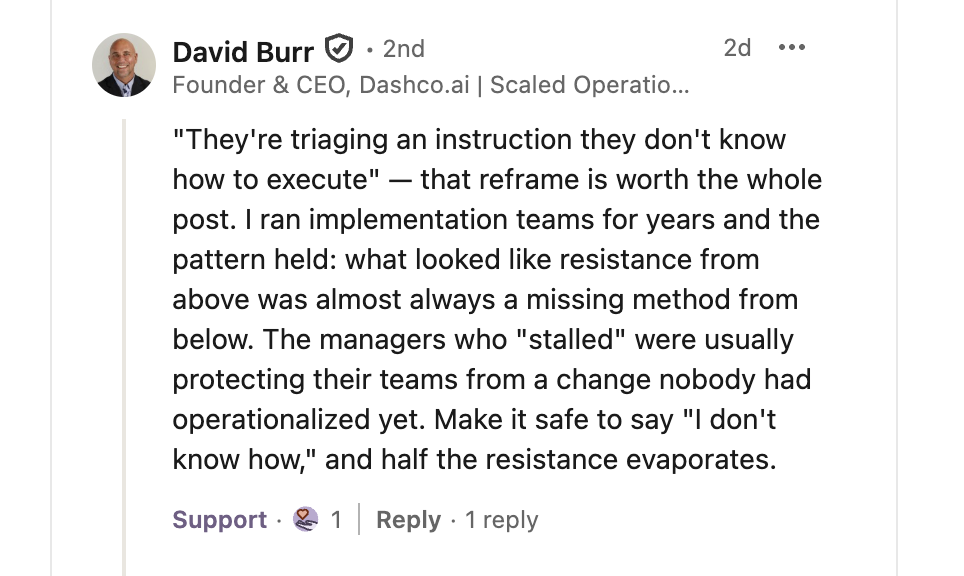
David Burr put it well in the comments last week.
The managers who "stalled" were usually protecting their teams from a change nobody had operationalized yet. Make it safe to say "I don't know how," and half the resistance evaporates.
The same is true on day one.
If it isn't safe to tell a new leader how things really are, the baseline is just a politer version of the story.
Wait too long, and you'll never see the before.
Before anybody sits down in that seat, I'd ask one question.
What does normal look like here, right now, written down?
If nobody can answer that, then the first job of whoever you hire isn't the change.
It's the baseline.
And if what it shows points back at the people who created the seat, you have to be willing to hear it.
Otherwise the person you hired is on their own.
This is the part of my work people understand least, so let me be plain about it.
Fractional culture and organizational development is the people side.
Culture, values, training and development, succession.
Not benefits, not payroll, not employee relations.
Every engagement I take on starts the same way.
Before anything gets designed, the organization gets heard.
What comes out of that first pass is a baseline, and the means to run it again, so you can check your own culture next year without starting over and without needing me in the room.
If you created the seat and haven't filled it yet, do this first, so whoever you hire starts with it.
If you're already sitting in it, I'm not a replacement for you.
People will usually tell an outsider what they won't tell their new boss.
Some of you are reading this and thinking you already run a survey, so you're covered.
Maybe you are.
When's the last time you compared this year's answers to last year's, out loud, with the people who gave them?
If the honest answer is that you haven't, you don't have a baseline.
You have a file.
Start the conversation at premierrapport.com/contact.
This is the third piece in The Second Finish Line, a series on the gap between the day we declare a change finished and the day it actually is.
Next: what happens after a deal closes, when the systems integrate right on schedule and the people don't.
Shelley D. Smith, the culture curator behind Premier Rapport, is its CEO and the author of Thirsty. A Certified Predictive Index Partner, executive coach, and speaker, she has spent 35+ years across hospitality, franchise operations, and organizational leadership helping companies detect and repair culture before it shows up in the numbers.
Learn more at premierrapport.com/about or start a conversation at premierrapport.com/contact.
AlixPartners, 10th Annual Private Equity Leadership Survey, fielded October to December 2024, 161 private equity executives and 200 portfolio company leaders, released March 2025.
Heidrick & Struggles, "Closing the Leadership Gap in Private Equity," reporting the 97% assessment figure against 61% in 2018.
Gartner, "Gartner HR Research Finds Foundational Pillars of High-Performing Business Culture Have Been Eroding Since 2022," survey of 18,000 employees worldwide, third quarter 2022 to second quarter 2025, press release October 2025.
What is a culture baseline?
A culture baseline is a written record of how an organization actually behaves at a fixed point in time, captured before a new leader or initiative changes it. It records observable behavior rather than sentiment scores: how decisions get made, who people go to when the process fails, and what language they use about the organization. Its purpose is comparison. It is the fixed point every later measurement gets read against.
How is a culture baseline different from an employee engagement survey?
An engagement survey is an assessment. It tells you what people report feeling today. A baseline is what you return to. The difference is not the instrument, it is whether the results are recorded, kept, and deliberately compared against later. A survey that is run once and filed is an assessment. The same survey, recorded at a known starting point and re-run against itself with the people who answered it, becomes a baseline.
What should a new CHRO or head of culture do in their first 90 days?
Record what you walked into, starting in week one. The first ninety days are not for fixing, because people behave differently the week someone new with authority arrives, and the pre-arrival state disappears quickly. Capture how decisions get made when leadership is out of the room, who people actually go to when the process doesn't work, and where the language has shifted from "we" to "they." Then build the mechanism to run it again.
What are leading indicators of workplace culture?
Leading indicators are behaviors that shift before the numbers do: energy changes in meetings, questions that used to be asked and aren't anymore, pronoun drift from "we" to "they," and the informal routing of problems around a broken process. Lagging indicators such as turnover, engagement scores, and exit interviews confirm what already happened. Leading indicators give a nine to twelve month head start.
Can you create a culture baseline if you have already been in the role for a year?
Yes, but you can't recover the before. You can't reconstruct a baseline retroactively by asking people what things used to be like, because memory reshapes itself around what happened since. What you can do is set the baseline today and stop the loss from continuing. A baseline set in month twelve still makes months thirteen through twenty-four provable.
Explore articles, case studies, and resources - crafted to keep you ahead.