
It’s rarely what you do that breaks culture, it’s when. Learn the 3 timing disciplines that separate reactive leaders from resilient ones: morning rhythm, blunt truth, and expectation management.

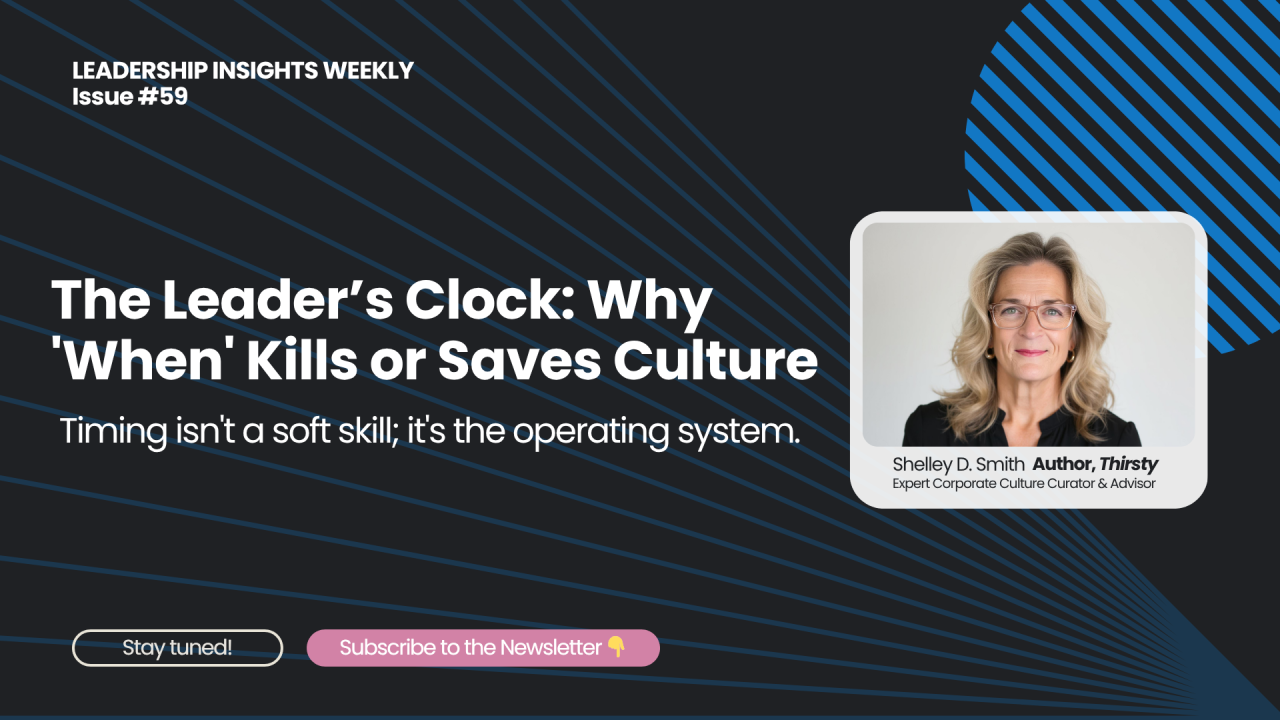
Timing isn’t a soft skill. It’s the operating system of leadership.
When you respond. When you decide.
When you deliver. When you protect space for hard truths.
My 35 years working with leaders has shown me that culture doesn’t break during the crisis.
It breaks during the 47 small moments before, when people chose silence over honesty because honesty felt too expensive.
The leaders who control timing shape everything downstream.
I want to walk you through three timing disciplines that separate reactive leaders from resilient ones.
How you start your day, how you protect blunt truth in real time, and how you manage expectations without burning trust.
Picture this: you step into the day like a river starting to move.
If you push and force, it splashes and sputters. If you set a steady current, everything downstream flows.
Leaders who perform under pressure don’t sprint at morning tasks.
They set a rhythm that protects attention, clarity, and composure.
As one recent piece put it, “High performers love to race time, but great leaders learn to pace it.”
I did this myself after years of noisy mornings, and it changed my weeks.
Start with fundamentals: consistent sleep, no-snooze discipline. You can’t pace a day on an empty battery.
Flip the switch: hydrate, then move lightly for 5–15 minutes. Simple, but it signals direction.
Protect a focus block first thing. Pick one priority and give it 60–90 minutes. Leaders get disproportionate leverage from one deep, aligned hour.
Research on daily rhythms recommends protecting 90–120 minute focus blocks as a core structure (Brightwire Leadership).
Build micro-reset moments. After intense work, 3–5 minutes to clear cognitive clutter.
After demanding meetings, 10 minutes to wipe the “cognitive residue” (Brightwire Leadership).
Review context, not noise. Quick scan of yesterday’s decisions prevents chasing false urgencies - this is why leaders who summarize meeting outputs before acting save hours (Plaud).
Keep buffer time. White space so a single interruption doesn’t collapse your rhythm.
Hold a first win. Send that hard email. Finish the paragraph you’ve been avoiding. Momentum compounds.
A leader’s meeting cadence - frequent, short syncs - keeps teams aligned and prevents urgency from becoming chaos (Nick Anderson, LinkedIn).
This isn’t a silver-bullet schedule. It’s a system to keep attention from evaporating.
I’ve watched two things happen in meetings.
Someone says the uncomfortable thing and the room tightens - or no one ever says it, and the real problem grows teeth.
Blunt honesty only helps if the team can hear it without the speaker getting punished.
That’s what psychological safety protects: the space where hard truths flow without triggering survival responses.
Google’s Project Aristotle found it was the single most important dynamic in effective teams (The New York Times).
Recent multilevel trials confirm that targeted interventions produce measurable improvements , but only when practiced consistently, not just discussed theoretically (Taylor & Francis Online).
Five practical moves to protect blunt truth this week:
Start with a tiny leader admission: “I don’t have the answer and I don’t want us to pretend we do.”
This models vulnerability and lowers stakes for others.
Install a 3-minute “What’s worrying me” slot in meetings.
Format: one worry, one fact that helps. This normalizes airing doubts as routine, not crisis.
Use “Issue + Intent” framing before critique: “Issue: the report missed X.
My intent: I want us to avoid the same risk.” Separates problem from person.
Make capacity visible every sprint: “Scale of 1–5, how much bandwidth do you have?”
Hidden overload is the number one reason people withdraw and withhold truth.
Create a short, confidential escalation path.
Who to contact, acknowledgment timeline, what happens next, what protection exists.
When people know there’s a predictable safe route, they take it sooner.
Measure the change: Two-question pulse — “I can speak up without negative consequences” and “Someone raised an uncomfortable truth and it was handled fairly.” Track the frequency.
Fewer late-night crisis messages means the system is working (Paramount Training).
Pick one of the five moves and use it three times this week.
My bet: the first use will feel awkward, the second will shift the room, and the third will make you want to keep going.
If that doesn’t happen, you’ve found exactly where the safety leak is, and that’s where to work next.
This connects directly to how communication currents shape culture.
The timing of truth-telling - early, routine, embedded in rhythm - determines whether problems get addressed when they’re small or discovered when they’re catastrophic.
Before we move to timing across client relationships, remember - “client” doesn’t always mean the customer outside your organization.
It’s anyone whose expectations you manage, your boss, your peers, your team.
Culture breaks the same way in all directions when timing slips between intention and delivery.
When you promise a fast turnaround you can’t keep, you don’t just disappoint - you eat future trust. Speed matters, but perceived predictability matters more.
McKinsey’s recent work on service expectations shows 70% of buyers saw no improvement from providers over the past decade, and eight in ten plan to change how they buy services (McKinsey).
If your timelines wobble, you’re vulnerable.
Book the work, don’t start day one. Secure commitment with a signed agreement plus deposit. That locks commitment and gives scheduling breathing room (Consulting Success).
Create pre-project value. Short activities you deliver while the engagement queues - a 30-minute orientation call, a diagnostic checklist, a one-page plan. People feel progress even when deep work hasn’t started.
Be surgical with expectations. Replace vague promises with three clear anchors: start date, key milestones, first visible outcome. Write them in the contract and repeat them in onboarding.
Triage publicly. Transparent priority matrix: urgent/strategic gets X lead time, standard gets Y, small requests go to a deferred queue. Consistency beats apology.
Picture your business as a river: control intake, smooth flow, and you stop fighting droughts and floods.
The leader’s clock isn’t about doing more. It’s about timing what matters.
Protect your morning rhythm, create space for hard truths, manage expectations with predictable systems, and you buy the single thing every leader needs more of: time.
Shelley D. Smith, the culture curator behind Premier Rapport, is its CEO and the author of Thirsty. A Certified Predictive Index Partner, executive coach, and speaker, she has spent 35+ years across hospitality, franchise operations, and organizational leadership helping companies detect and repair culture before it shows up in the numbers.
Learn more at premierrapport.com/about or start a conversation at premierrapport.com/contact.
How does timing affect workplace culture?
Timing is the operating system: when you respond, decide, deliver, and protect space for truth. Culture breaks during small moments when people chose silence because honesty felt expensive. Leaders who control timing shape culture more than those focused only on what they do.
What morning habits make leaders more effective?
No-snooze discipline, hydration, light movement, protected 60–90 minute focus block, micro-resets between tasks, context review over noise-chasing, buffer time, and one early “hard thing” for momentum. This protects attention and composure that shape every downstream interaction.
How do you create psychological safety in meetings?
Five moves: leader admission of uncertainty, 3-minute “what’s worrying me” rounds, issue-plus-intent framing, visible capacity checks, and confidential escalation paths with response timelines. Measure with two-question pulses tracking speaking-up comfort and fair handling of uncomfortable truths.
How do you manage turnaround expectations without losing trust?
Predictable systems: secure commitments before starting, create pre-project value during queue time, replace vague promises with three clear anchors, establish transparent priority matrices, and tighten every touchpoint. Perceived predictability matters more than raw speed.
Explore articles, case studies, and resources - crafted to keep you ahead.