
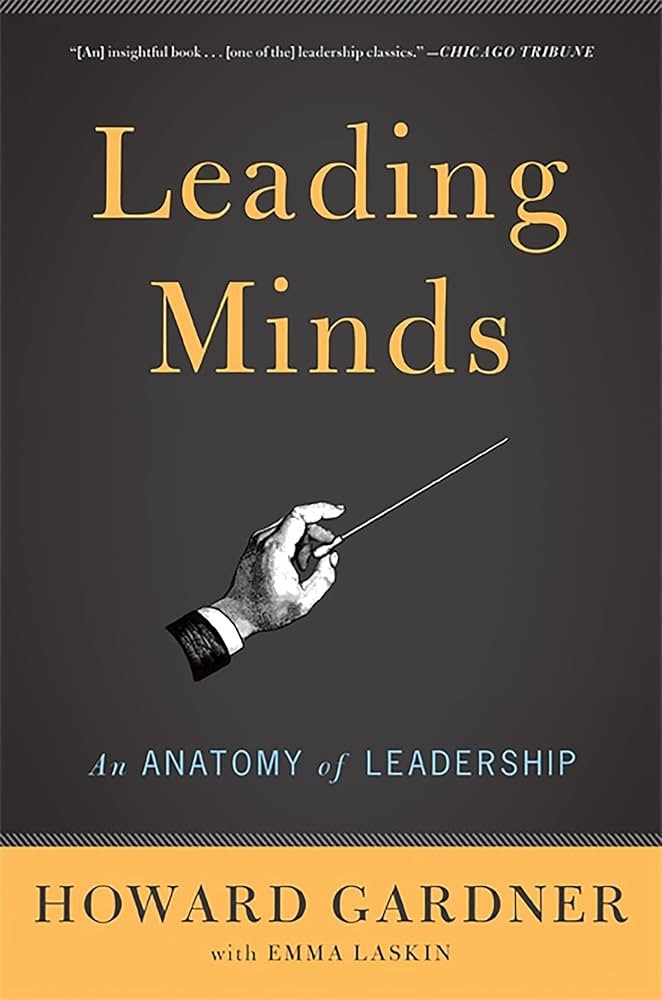
Technical expertise blinds leaders to culture signals. Howard Gardner's research confirms what 35+ years of pattern recognition taught me about the leadership detection gap.


Howard Gardner's research on leadership confirmed something I'd been watching play out in real organizations for decades, and it's the piece that most leadership development programs completely miss.
Gardner calls it the shift from technical expertise to narrative influence.
As leaders advance, the skills that got them promoted (analytical precision, operational mastery, domain knowledge) become less important than the skills nobody taught them: reading a room, sensing a shift, detecting when their team has stopped telling them the truth.
I call it the Expertise Paradox.
And after 35+ years of walking into organizations where the most technically brilliant leaders were also the most culturally blind, I can tell you it's the single most expensive leadership gap in business today.
Here's the pattern I see constantly: a leader rises through the ranks because they're exceptional at their craft.
Engineering, finance, operations, healthcare, doesn't matter the domain.
They get promoted because they solve problems.
And they keep solving problems, because that's what got rewarded.
But somewhere around the VP or C-suite level, the game changes.
The problems that matter most aren't technical anymore. They're human.
And the leader's entire toolkit, the thing that made them brilliant, is calibrated for a different kind of signal.
I was working with a CEO who ran an engineering firm, sharp, detail-oriented, data-driven.
His engagement dashboard was green.
Revenue was growing.
And he could not understand why his senior team kept leaving.
"I've given them everything," he told me. "Competitive comp, flexible schedules, clear goals."
Within 20 minutes of sitting in his leadership meeting, dare I say even less, I could feel it.
One person talking.
Everyone else listening.
Or kind of listening.
No pushback, no questions, no building on ideas. Just compliance.
The CEO had created an operationally efficient machine where nobody felt safe enough to disagree with him.
His expertise had become the barrier to the very culture he wanted.
That's the paradox. The more you know, the less you see, unless someone helps you see it differently.
Gardner studied 11 influential 20th-century leaders and identified something the leadership industry still hasn't absorbed: the most effective leaders aren't the ones who master every competency.
They're the ones who learn to read and shape the story their organization tells itself.
That's not a skill you develop in a leadership seminar. It's a detection skill.
And it's exactly what gets suppressed as technical expertise grows.
I've been watching this cycle repeat for my entire career.
In the nineties, we trained leaders on Six Sigma and process optimization.
In the 2000s, it was emotional intelligence workshops.
Now it's AI analytics.
Each decade, we add another tool to the leader's technical toolkit while the foundational ability, sensing what your people actually need, keeps atrophying.
The organizations that break this cycle are the ones that combine two things: objective behavioral data and human observation.
Neither one alone is enough.
This is where the Predictive Index becomes a culture detection tool rather than just a hiring tool.
PI measures four behavioral drives: dominance, extraversion, patience, and formality.
Most organizations use this data to improve team composition and hiring. That's valuable.
But the real power, the piece I've spent almost 15 years learning to leverage, is using behavioral data to explain the Expertise Paradox in real time.
That CEO with the engineering firm? His PI profile showed high dominance and high formality, a pattern that naturally gravitates toward structure, precision, and control.
Nothing wrong with that.
But it also meant he was structurally wired to value efficiency over vulnerability and answers over questions.
His leadership style didn't suppress psychological safety on purpose. It suppressed it by design.
Once he could see his own behavioral wiring, not as a flaw, but as a blind spot, he could start compensating.
Not by changing who he was, but by deliberately creating space for the signals he naturally filtered out.
Observation tells you what's happening in the room. The energy dropped. The team went silent. The language shifted.
Behavioral data tells you why the room configured itself that way. And that combination gives leaders something rare: the ability to detect culture dehydration in real time, not 9-12 months later when the dashboard finally catches up.
Gardner's research points to two types of leaders: direct leaders who influence through personal engagement, and indirect leaders who influence through ideas and systems.
Most technically skilled leaders default to indirect influence, building better systems, creating clearer processes, optimizing structures.
But culture doesn't respond to systems the way operations does.
Culture responds to presence.
To the five-minute conversation where a leader asks "what do you need from me?" and actually listens to the answer.
To the meeting where the most senior person speaks last instead of first.
To the daily deposits, not the quarterly initiatives.
Maybe this sounds basic.
Maybe I'm being naive in thinking it needs to be said.
But I keep walking into organizations run by extraordinarily smart people who have optimized everything except the thing that matters most: whether their team feels seen, valued, and heard.
The Expertise Paradox isn't a character flaw.
It's a predictable consequence of how we develop leaders.
And the fix isn't more training, it's better detection.
Shelley D. Smith, the culture curator behind Premier Rapport, is its CEO and the author of Thirsty. A Certified Predictive Index Partner, executive coach, and speaker, she has spent 35+ years across hospitality, franchise operations, and organizational leadership helping companies detect and repair culture before it shows up in the numbers.
Learn more at premierrapport.com/about or start a conversation at premierrapport.com/contact.
Howard Gardner, "Leading Minds: An Anatomy of Leadership"
What is the Expertise Paradox in leadership?
The Expertise Paradox describes how leaders become less attuned to culture signals as their technical expertise grows. As leaders advance, they rely increasingly on analytical and operational skills while their ability to detect emotional undercurrents, team energy shifts, and belonging deficits atrophies. This creates a detection gap where the most technically qualified leaders are often the most culturally blind.
How does the Predictive Index help leaders detect culture problems?
The Predictive Index measures behavioral drives, dominance, extraversion, patience, and formality, providing objective data about how people are wired to work. This data helps explain why certain leaders miss culture signals: a high-dominance, low-patience leader naturally filters for results and efficiency, making them structurally less likely to notice the slow erosion of psychological safety or belonging. PI data makes the invisible visible.
Why do technically skilled leaders struggle with workplace culture?
Technical expertise trains leaders to solve problems they can define and measure. Culture dehydration operates in the space between measurable metrics, the meeting energy that went flat, the VP who stopped asking questions, the shift from "we" to "they" in language. These signals require observational skills that technical training doesn't develop and often actively suppresses.
Explore articles, case studies, and resources - crafted to keep you ahead.