
AI automates data analysis but can't read the room. Learn why Cultural Hydration Intelligence, the human ability to sense what metrics miss, is the real competitive advantage in the AI era.

I was discussing the role of humanity in workplace productivity with a colleague over a Zoom call last week.
The conversation was intense.
We were exploring how AI is reshaping our industry and what it means for the future of work.
One of my team members made an observation that stopped me cold:
"It feels like we're being asked to choose between being human or being relevant."
The comment hung in the digital air for a moment.
Then another colleague chimed in:
"What if the real competitive advantage isn't choosing between human and AI, but knowing how to blend them?"
That's when it clicked.
While many organizations are either racing to become more like machines or desperately clinging to outdated approaches...
The real opportunity is something entirely different: intentional human-AI collaboration that puts relationships at the center.
Here's what most leaders, whether they're AI-obsessed or AI-resistant, are missing.
Your culture isn't broken because you need better tools or processes.
It's dehydrated because you've forgotten how to see, hear, and connect with the humans in your organization.
One of my colleagues shared a powerful insight during our discussion: "We're so focused on optimizing systems that we've forgotten we're optimizing for humans."
People are desperate for connection.
They don't need another efficiency report generated by AI.
They need someone who can walk into a room and immediately sense that the engineering division doesn't trust the product team.
Someone who can spot the subtle signs that your "successful" remote work policy is actually creating dangerous cultural fissures.
This is what I call Cultural Hydration Intelligence.
The ability to diagnose, understand, and restore the human connections that make organizations thrive.
20 minutes into a conversation that maybe wasn't a conversation, it was one person talking, everyone else listening or kind of listening, that speaks volumes.
AI's gonna transcribe everything the CEO said.
But it's not going to read the facial expressions. It's not gonna pick up the text messages at the table, the DMs on the Zoom call.
It's gonna miss the meeting after the meeting, or the meeting happening during the meeting.
Think about it.
When was the last time you had a real conversation with someone three levels below you?
Can you spot the difference between engagement and compliance in your team meetings?
Do you know what your star performer is actually afraid of?
These aren't metrics you can automate.
They're human intelligence capabilities that require intention, practice, and presence.
Let me be clear: traditional measurement isn't dead.
But it's fundamentally changing, and most organizations are approaching the shift backwards.
They're asking: "How do we use AI to do what we've always done, but faster and cheaper?"
We're asking a different question: "How do we use AI to become more human, more insightful, and more connected to the people we serve?"
The difference is profound.
AI handles the data analysis. We focus on reading the room.
AI identifies patterns. We interpret what those patterns mean for real people.
AI provides rapid insights.
We add the interpretive, ethical, and empathetic layers that turn insights into transformation.
This isn't about rejecting technology.
It's about understanding that in a world where everyone has access to the same AI tools, your competitive advantage lies in how skillfully you blend artificial intelligence with human wisdom.
I've watched this evolution play out across decades. In the nineties it was "empower with boundaries and all shall be fixed."
The 2000s brought new digital tools. Now it's AI.
Different technology, same fundamental question: are you using tools to understand people better, or are you using tools to avoid understanding people at all?
Here's the critical difference. Some organizations use AI to replace human judgment.
The ones that win use AI to amplify human insight.
When I walk into an organization and see the physical distance between divisions, I don't need an algorithm to tell me there's a trust problem.
But I might use AI to help analyze communication patterns, track engagement metrics, or model different intervention scenarios.
The key? The human stays in the driver's seat.
The technology serves the relationship, not the other way around.
Within 20 minutes of walking into an organization, dare I say even less, I've got a vibe.
The feeling, the atmosphere. How was I greeted, into the elevator, walking by people. Who's talking, who's not talking. The email exchanges ahead of time tell me a lot.
The words, the body language, the stories, the depth, the emotion you feel or you don't feel out of the sincerity of their stories. It tells you a lot about how they lead.
No algorithm reads that. No dashboard captures it. And yet it tells you everything.
When did you last have a conversation that changed how you see your culture?
Not a survey readout. Not an engagement report. A real conversation.
What would happen if you spent as much time developing emotional intelligence as you do implementing new systems?
How would your organization change if leaders were as skilled at reading human dynamics as they are at reading financial reports?
Culture isn't built through grand initiatives or policy changes.
It's built through daily choices and consistent attention to the humans in your organization.
The organizations winning the culture war in the AI era aren't the ones with the best technology.
They're the ones that sit in meetings and notice what's not being said.
That observe the micro-interactions that reveal macro-problems.
That develop the human intelligence capabilities no algorithm can replicate.
The leadership world is splitting into two camps: those who see people as problems to be solved by technology, and those who see technology as a tool to better understand and serve people.
Which camp is your organization in?
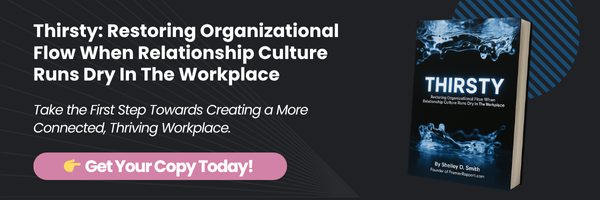
This is the progression I explore in depth in Thirsty.
How organizations move from treating culture as a tech problem to treating it as a human system that technology can support but never replace.
Shelley D. Smith, the culture curator behind Premier Rapport, is its CEO and the author of Thirsty. A Certified Predictive Index Partner, executive coach, and speaker, she has spent 35+ years across hospitality, franchise operations, and organizational leadership helping companies detect and repair culture before it shows up in the numbers.
Learn more at premierrapport.com/about or start a conversation at premierrapport.com/contact.
Leading indicators include behavioral signals that surface months before traditional metrics: the shift from "we" to "they" language, meeting energy and participation patterns, question quality in team settings, information flow speed between departments, and whether concerns surface early or get buried. These require Cultural Hydration Intelligence, the ability to read rooms and sense dynamics that algorithms can't replicate.
Culture measurement is evolving from backward-looking surveys to forward-looking human-AI collaboration. AI excels at analyzing communication patterns and tracking engagement metrics. But the most critical signals, meeting energy, trust dynamics, the gap between what's said and what's felt, require human observation. The future belongs to organizations using AI for data while freeing leaders to read rooms and interpret emotional context.
The most predictive metrics are behavioral: pronoun usage patterns, voluntary cross-department collaboration, speed of concern escalation, meeting participation dynamics, and the gap between leadership beliefs and employee experience. These require combining AI analysis with human interpretation. Neither alone provides the complete picture.
Cultural Hydration Intelligence is the ability to diagnose, understand, and restore human connections that make organizations thrive. It requires sensing what no survey captures: the energy when walking into a building, the sincerity in stories, the difference between engagement and compliance, what star performers are actually afraid of. AI can track data trails, but the early sensing is human territory.
Explore articles, case studies, and resources - crafted to keep you ahead.