
A 5-minute daily ritual outperforms a $240K culture lab. The First Drop Principle places one small habit at the right leverage point, and behavior rewires before resistance wakes up.

Picture this: It's 11:57 p.m.
Your phone buzzes with a subject line that could curdle milk, "HELP. Budget's on fire."
Sound familiar?
Maybe you've sent that email yourself.
The sender in my story had just wired $240K to a "culture lab." The invoice went through.
But months later, the culture?
Still gasping for air.
Engagement flatlined.
Exit interviews spiked.
The CFO circled the P&L with a red marker big enough to see from space.
If any part of that scene makes your stomach clench, keep reading.
You're about to learn how one five-minute ritual can outperform an army of misinformed consultants.
And how you can copy it before quarter-end.
Gallup puts the global cost of employee disengagement at $8.8 trillion a year.
McKinsey figures culture misfires bleed hundreds of millions off the balance sheet of the average S&P 500 company every single year.
Numbers this loud should dominate every slide deck, yet the true cost of failed culture still gets shunted to the margins.
Why do company-wide "transformations" keep blowing up?
Because most of them try to jam a generic key into a very specific lock.
Big, noisy, and the wrong fit from day one.
Yet a renegade 10% of teams quietly flip the script.
They spend less, change more, and walk away looking like wizards.
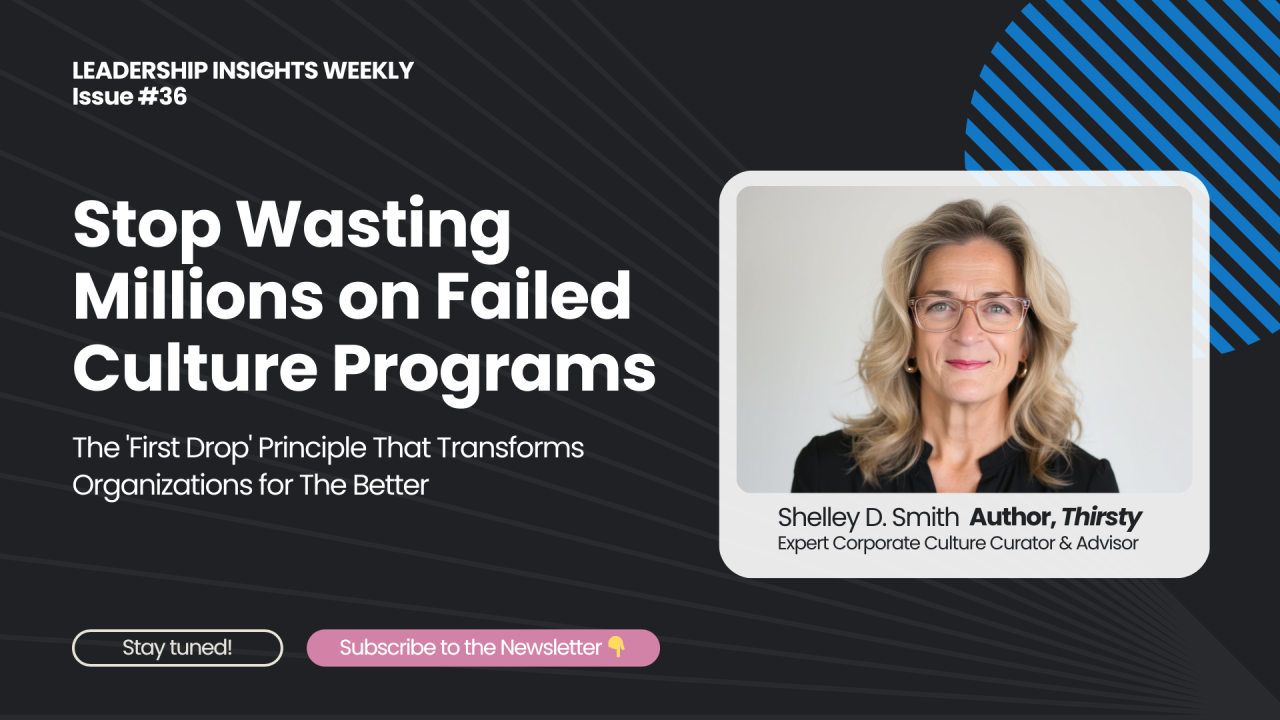
Their secret is what I call the First Drop Principle: drop one tiny habit at the perfect leverage point, and behavior rewires itself before resistance even wakes up.
Think of it like letting a single raindrop find the gutter crack that floods an entire street. Small input. Huge, unstoppable flow.
In Thirsty, Tom Sullivan runs the Maritime Division at Carrington & Sons.
His team's morale is brittle enough to squeak.
Leadership retreats?
Eye-roll festivals.
Values posters?
Dartboards.
Desperate, Tom tries a different approach.
He slides one question into the 8:15 a.m. standup: "What helped you do your best work yesterday?"
Week 1: Crickets.
Shuffling shoes.
Week 3: Folks showed up with answers pre-loaded.
Week 6: Teammates began nominating each other, unprompted.
Month 3: The question evolved on its own, "How can we help each other do our best work today?"
No extra consultants.
No memos.
Five minutes.
The result?
Engagement up 37%.
Turnover down 42%.
Payroll churn dropped hundreds of thousands in year one.
The lesson? Tiny drops carve canyons.
Tom didn't add work, he swapped five minutes of status fluff for five minutes of purpose.
Three realities explain why micro-interventions succeed where massive initiatives fail:
Threat Bypass. Big-bang change screams danger to your limbic system.
Micro-moves slip under the radar like a friendly text.
Your brain's resistance mechanism never activates.
Behavior shapes Belief. We act our way into new beliefs, not the other way around.
Repeat the drop and identity rewires itself.
The belief follows the behavior.
Systems Leverage. Organizations are ecosystems, not machines.
Drop your habit at a high-frequency node, a daily ritual, a regular meeting, and watch the ripples multiply through the system.

Every organization has a handful of high-leverage spots where a tiny, well-placed habit sends shockwaves of positive change.
Think of them as cultural acupuncture points, they're probably lurking in the meetings, messages, and decisions you already make.
1. Daily Rituals. Standups, shift handovers, project check-ins.
Because they repeat so often, even a small tweak lands big.
Slip Tom's five-word question into tomorrow's huddle and watch the tone shift.
2. Recognition Signals. How and when you acknowledge wins hardwires what people chase.
One specific, on-the-spot shout-out each day delivers the dopamine hit that posters and plaques never could.
3. Problem Responses. The first words you speak when something goes sideways dictate whether your team tightens up or leans in.
Try a "Gift in the Glitch" round, "What can this setback teach us?", to set a constructive default.
4. Information Flow. News travels fast or it festers.
A plain-English recap at the end of a project meeting keeps transparency high and rumor-mills idle.
5. Decision Visibility. People buy into what they can see.
Close each call with a two-sentence wrap-up: "What did we decide? Why?" Instant clarity, zero spin.
Pick the point that feels friction-free and drop your first micro-move there. Flow loves the path of least resistance, and so will your team.
Connection Rounds. At a healthcare organization dealing with siloed departments, they introduced a "Connection Before Content" rule at every shift change.
First five minutes?
Share a quick patient-progress win, then tackle the problems.
Six months later, collaboration soared, satisfaction scores jumped 28%, and errors fell by a third.
All from repurposing five minutes they already spent talking.
Visibility Moments. At an organization split across desks and Zoom screens, they opened every meeting with a three-minute ritual: each person names one challenge they need help with, title, time zone, and ego aside.
Remote team members who once felt invisible became essential voices.
Stalled projects found momentum through crowd-sourced problem-solving.
Recognition Shift. At a financial-services firm I coached, genuine praise had vanished.
Leaders pledged one micro-habit: spot one specific positive action each day and call it out on the spot.
No vague "good job", concrete impact.
In a few months, engagement up 41%.
Innovation ideas tripled.
Five intentional minutes, once a day.
Step 1: Identify your top cultural acupuncture point, the daily moment with the most repetition and the most people present.
Step 2: Design a micro-intervention that takes five minutes or less and targets behavior, not attitudes.
Step 3: Commit to one intervention this week.
Start small enough that it doesn't trigger resistance, choose a regular interval, and allow natural evolution.
The key isn't the size of your intervention but its placement and persistence.
As Tom's story shows, and as I explore further in how drops become rivers, twelve months after that humble question, Carrington wasn't just saving cash.
It was magnetizing talent.
Top performers started cold-emailing HR.
Culture became their moat. And it started with one drop.
Shelley D. Smith, the culture curator behind Premier Rapport, is its CEO and the author of Thirsty. A Certified Predictive Index Partner, executive coach, and speaker, she has spent 35+ years across hospitality, franchise operations, and organizational leadership helping companies detect and repair culture before it shows up in the numbers.
Learn more at premierrapport.com/about or start a conversation at premierrapport.com/contact.
Gallup, State of the Global Workplace Report
McKinsey & Company, organizational culture research
What is the First Drop Principle?
The First Drop Principle is a micro-intervention methodology: place one tiny habit at a high-frequency leverage point, and behavior rewires before resistance wakes up. Small input, unstoppable flow.
What are the most effective daily leadership habits for culture?
Target five acupuncture points: daily rituals (one question in standup), recognition signals (one specific shout-out), problem responses (gift in the glitch round), information flow (plain-English recap), and decision visibility (what did we decide, why). Each takes under five minutes.
Why do big culture transformation programs fail?
Big-bang change triggers the brain's threat response. Micro-interventions bypass resistance. Additionally, behavior shapes belief, repeat the small drop consistently and identity rewires itself.
How do small actions impact workplace culture?
Small actions create disproportionate impact at cultural acupuncture points. One organization saw 37% engagement increase and 42% turnover reduction from a single five-minute daily question. Placement and persistence matter more than scale.
Explore articles, case studies, and resources - crafted to keep you ahead.